
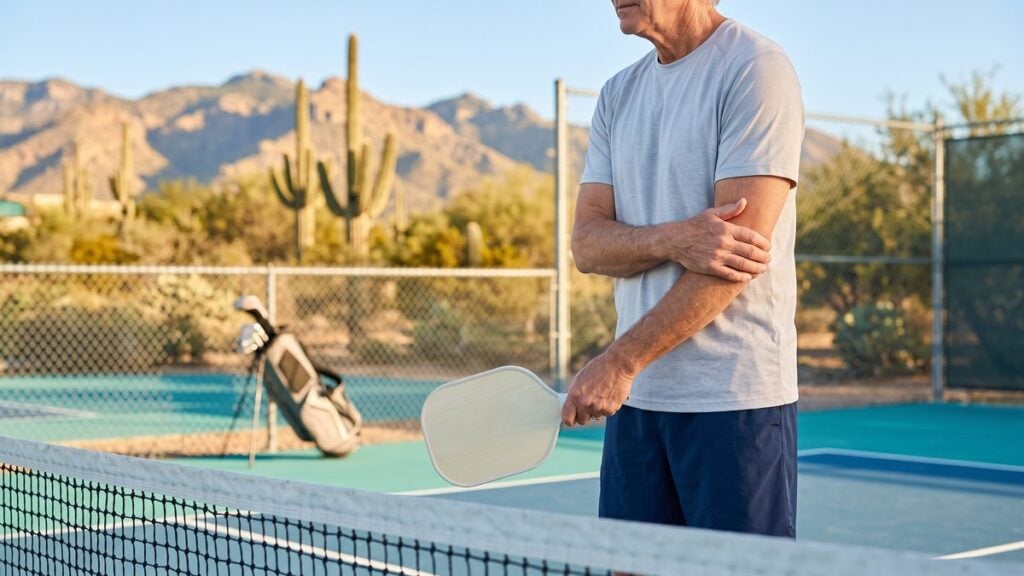
Tennis elbow vs golfer’s elbow: which one is behind the ache in your arm? Both come from overuse, and both can make a coffee cup feel heavy. However, they affect opposite sides of the elbow. You also do not need to play either sport to get one.
When the weather cools, many of us head back to the golf courses and pickleball courts around Oro Valley and SaddleBrooke. As a result, sore elbows follow. This guide explains how to tell the two apart and what helps at home. It also covers the treatments we offer and when elbow or joint pain deserves a same-day exam.
Key takeaways
- Tennis elbow hurts on the outside of the elbow. Golfer’s elbow hurts on the inside.
- Both are overuse injuries of the forearm tendons, so pickleball, tools and household chores cause them too.
- Most cases heal without surgery. Instead, the usual first steps are rest from the trigger, ice, a forearm strap and exercises.
- Sanova can start treatment for both in one walk-in visit, with in-office pain relief, braces, steroid injections and X-ray.
- Get checked if pain lasts more than two weeks, comes with numbness or keeps coming back.
- Above all, come in the same day after a fall. Do the same if the elbow will not fully straighten or turns hot, red and swollen.
Tennis elbow vs golfer’s elbow: a quick comparison
| Feature | Tennis elbow | Golfer’s elbow |
|---|---|---|
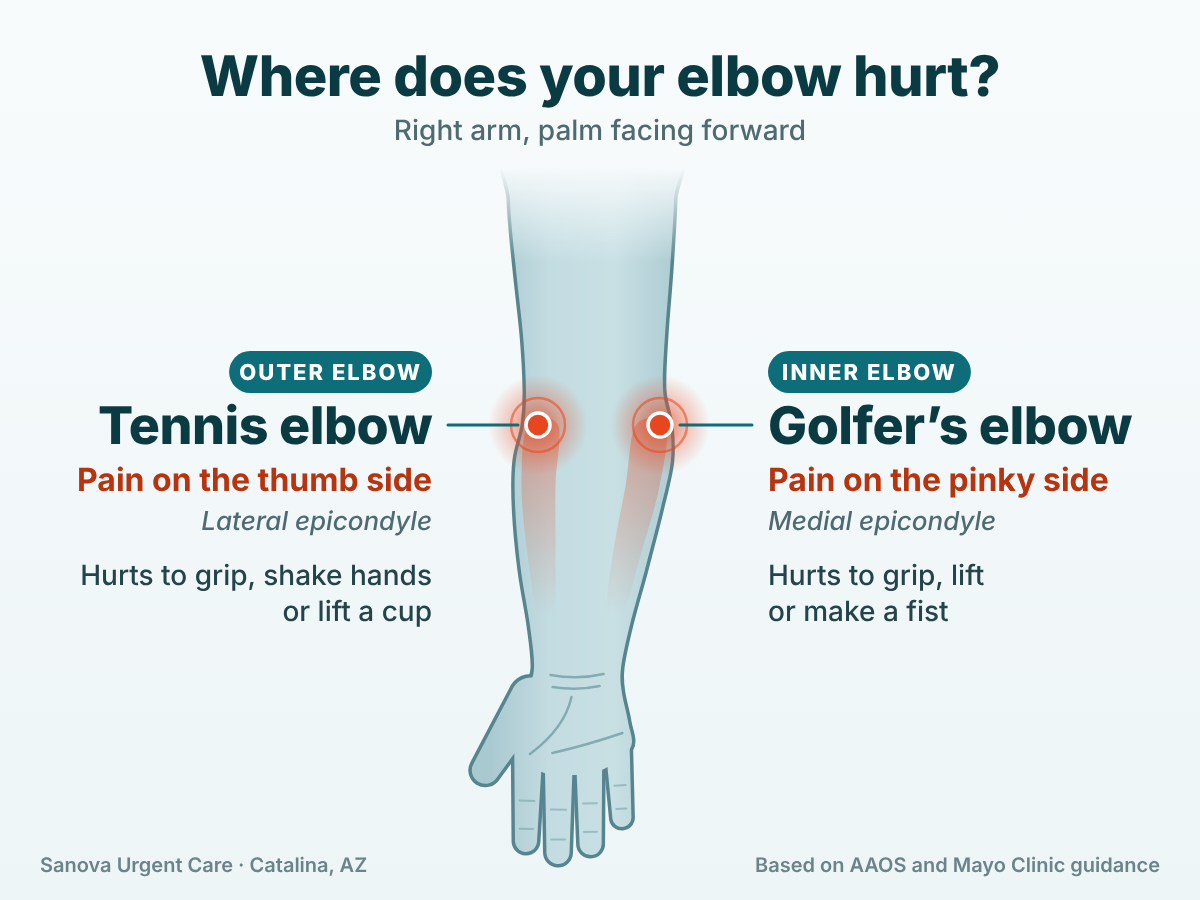
| Where it hurts | Outside of the elbow | Inside of the elbow |
| Medical name | Lateral epicondylitis | Medial epicondylitis |
| Tendons involved | Outer forearm tendons that bend the wrist back | Inner forearm tendons that bend the wrist forward |
| Hurts most when you | Grip, shake hands, turn a doorknob or lift a cup | Grip, lift, make a fist or bend the wrist forward |
| Common triggers | Racquet and paddle sports, painting, plumbing, carpentry | Golf, throwing, weightlifting, household chores |
| Most common ages | 30 to 50 | 40 to 60 |
These details come from the American Academy of Orthopaedic Surgeons (AAOS) guides to tennis elbow and golfer’s elbow. The everyday examples come from Mayo Clinic’s tennis elbow page and its golfer’s elbow page. However, both conditions can also show up outside those age ranges.
What is tennis elbow?
Tennis elbow is an overuse injury of the tendons on the outside of the elbow. These tendons anchor the forearm muscles that bend your wrist back and steady it when you grip. Eventually, repeated strain causes wear and tiny tears where the tendon meets the bone.
Despite the name, most people who get it are not tennis players. For example, Mayo Clinic notes that plumbers, painters, carpenters, butchers and cooks are more likely to develop it. In addition, MedlinePlus lists repeated screwdriver use and repetitive typing and mouse use. Pickleball players call it pickleball elbow, but it is usually the same injury.
Common symptoms include:
- Pain or burning on the outer part of the elbow
- A weak grip
- Pain when you shake hands, turn a doorknob or hold a coffee cup
- Sometimes, pain at night
It usually strikes the dominant arm. However, it can show up in either arm.
What is golfer’s elbow?
Golfer’s elbow is the same kind of injury on the opposite side. It affects the tendons on the inside of the elbow instead. Those tendons anchor the muscles that bend your wrist forward and close your hand.
Golf is only one cause, though. The AAOS also lists overhead throwing, tennis and weightlifting. In addition, everyday household chores can bring it on without a single injury. It usually appears between ages 40 and 60.
Common symptoms include:
- Pain or burning on the inner part of the elbow
- Pain that sometimes shoots down the forearm toward the hand
- A weak grip or a stiff elbow
- Numbness or tingling in the ring and little fingers, when the nearby nerve is irritated
Mayo Clinic adds that risk rises after age 40. Other risk factors include two or more hours a day of repetitive motion, smoking, diabetes and extra weight.
A quick self-check you can do at home
When it comes to tennis elbow vs golfer’s elbow, this check offers a clue rather than a diagnosis. Skip it after a fall or a hard blow, and come in for an X-ray instead.
- Outer side. Turn your palm up. The outer side of the elbow is now the thumb side, so press on the bony bump there. Then hold your arm straight with the palm down. Finally, lift the back of your hand against light pressure from your other hand. Pain at the outer bump points toward tennis elbow.
- Inner side. Press on the bony bump on the inner side, nearest your body. Then keep your arm straight, turn your palm up and curl your wrist against light pressure. Pain at the inner bump points toward golfer’s elbow.
These moves mirror what a clinician checks during an exam. But if neither spot is tender, or the whole joint is swollen or stiff, something else may be going on.
Why golf and pickleball season brings elbow pain to Oro Valley and SaddleBrooke
Golf, tennis and pickleball are part of daily life in SaddleBrooke, Sun City Oro Valley and across Oro Valley. Once the heat breaks, play picks up fast. Winter visitors also return and jump straight into a full schedule.
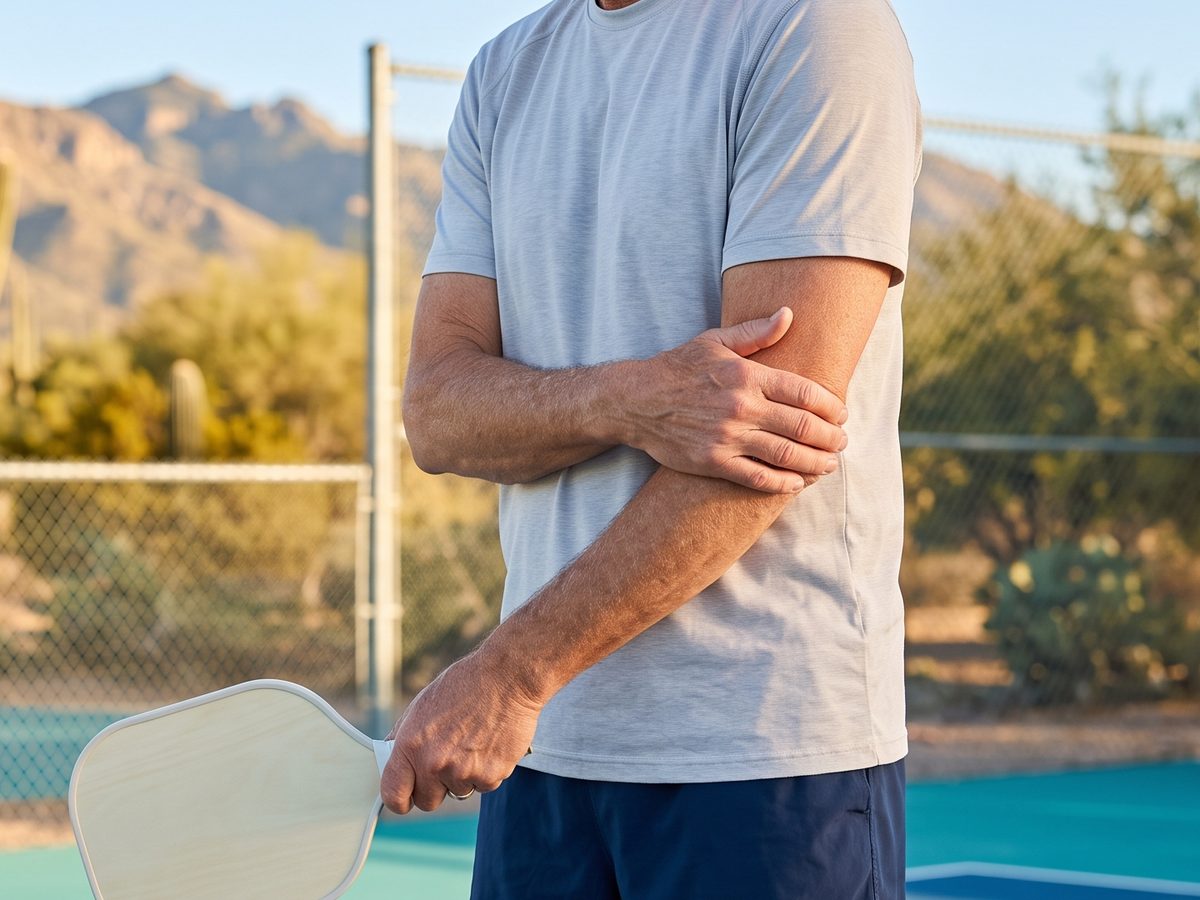
However, that sudden jump is hard on forearm muscles that are not yet conditioned for it. Meanwhile, pickleball keeps growing. A national study estimated about 600 pickleball injuries treated in emergency rooms in 2013 and more than 13,000 in 2022. Across those ten years, players aged 65 to 80 accounted for about six in ten of the injuries.
Those figures count emergency visits only, and fractures and sprains led the list. Overuse problems such as pickleball elbow build slowly instead, so they are easy to ignore at first. If you are here for the winter, our guide to snowbird health care covers what else to plan for.
Is it the tendon or the joint? Other causes of elbow pain
Not every sore elbow is a tendon problem. Instead, the joint itself, a nerve or a bone is sometimes the source. For example:
- Bursitis. A swollen lump at the tip of the elbow points to the fluid-filled sac there. In addition, the AAOS notes that redness and warmth can signal an infection.
- Gout or arthritis. Gout can strike the elbow with sudden, intense pain and a swollen, warm, red joint. Elbow arthritis, on the other hand, tends to cause pain, lost motion and a grating or locking feeling.
- An irritated nerve. Numbness and tingling in the ring and little fingers, especially with the elbow bent, point to the ulnar nerve.
- A fracture. After an injury, an elbow that will not fully straighten needs an X-ray, which we take on site. In fact, nearly half of such patients had a broken bone in one large emergency department study. Being able to straighten the elbow lowers the odds of a fracture but does not rule one out.
- The neck. Arthritis or a herniated disk in the neck can also cause arm pain, as the AAOS notes.
We see all of these at Sanova. Golf and pickleball also strain knees, shoulders, wrists and the lower back. Our back, neck, knee and joint pain page explains how we treat those too. After a fall, our guide to a sprain, strain or broken bone can help too.
What helps at home first
Most mild cases settle with simple steps, so start with these:
- Rest from the trigger. This does not mean total rest. Instead, cut back on the activity that hurts for a few weeks.
- Ice. Apply a cold pack wrapped in a towel for 15 to 20 minutes, a few times a day.
- Pain relievers. Acetaminophen can help for a few days. Follow the label, stay under the daily limit and ask first if you have liver disease. Ibuprofen or naproxen can help too. However, the FDA label for ibuprofen says to ask a doctor first if you are 60 or older. It says the same about ulcers, bleeding problems, high blood pressure and heart or kidney disease. MedlinePlus gives similar cautions for both drugs and includes blood thinners on its list. Stop and check in if pain lasts more than 10 days.
- A forearm strap. A counterforce brace sits on the forearm just below the elbow. As a result, it can take some stress off the sore tendon. We keep forearm straps and wrist braces in stock at the clinic.
- Stretching and strengthening. Forearm exercises are a mainstay of treatment, and we can give you a written home exercise plan.
- A gear and form check. A heavy paddle, a poor grip fit or old, heavy clubs add strain. Therefore, a lesson or a gear check can pay off.
Ease off, then rebuild strength gradually
Ease off the moves that hurt until the pain settles. Then rebuild strength a little at a time. In fact, Mayo Clinic calls exercises that rebuild strength and regain use of the elbow vital to recovery. For golfer’s elbow, the AAOS describes stretching first to regain full, pain-free wrist motion, and then strengthening. It adds that eccentric exercises, such as slowly lowering a light weight, may be especially helpful. For tennis elbow, the AAOS says specific exercises help strengthen the forearm muscles. The exercises differ for each side, so your written home plan will match the side that hurts. If an exercise makes the pain clearly worse, ease off and tell us at your recheck.
Tennis elbow vs golfer’s elbow: when to get it checked
Home care is a fair first step. However, come in if any of these apply:
- Pain has not improved after about two weeks of rest and home care
- You want faster relief than home care is giving you
- Pain wakes you at night or keeps you from working, gripping or lifting
- You see swelling or a lump at the tip of the elbow
- Numbness, tingling or weakness in the hand has crept in over days or weeks
- The pain keeps coming back
Come in the same day if any of these apply:
- The pain started with a fall or a direct blow
- You cannot fully bend or straighten the elbow
- You felt a sudden pop at the elbow, followed by bruising or weakness
- The elbow is hot, red and swollen, with or without a fever
Mayo Clinic says to get help right away for a possible broken bone or an elbow that will not bend. It says the same for a swollen, warm elbow with a fever. Infection does not always bring a fever, though, so do not wait for one. A pop can mean a torn tendon, and the AAOS says repair is ideally done within two to three weeks.
When to call 911 instead
Most arm pain comes from muscles, tendons or joints. Rarely, it comes from the heart or the brain. Call 911 right away for:
- Arm pain with chest pressure, shortness of breath, a cold sweat, nausea or lightheadedness
- Sudden weakness or numbness in one arm, a drooping face or trouble speaking
These can signal a heart attack or a stroke. The American Heart Association lists discomfort in one or both arms among the heart attack warning signs. It also notes that some heart attacks start slowly, with mild discomfort. Similarly, the American Stroke Association lists sudden arm weakness, face drooping and speech difficulty as stroke signs. Calling 911 is usually the fastest way to start treatment, so do not drive yourself.
For other elbow problems, start with us. Sanova Urgent Care is a walk-in clinic at 15883 N Oracle Rd, Suite 101, in Catalina. We are open Monday through Saturday, 7am to 7pm, with no appointment needed. We offer in-office pain relief, steroid injections and on-site X-ray, and we keep braces in stock.
What to expect at Sanova Urgent Care
Telling tennis elbow vs golfer’s elbow apart rarely needs a long workup. Here is how a visit works:
- Walk in. You do not need an appointment, Monday through Saturday, 7am to 7pm.
- A focused exam. Your clinician presses on the bony points of the elbow and tests your wrist and grip against resistance. Often, that is enough to make the diagnosis.
- On-site X-ray when you need it. X-rays show bone, not tendon. Therefore, we use them after a fall, when motion is limited or to look for arthritis. See X-ray and fracture care.
- Treatment the same day. We can treat most elbow tendon problems right here.
Treatment options we offer
We offer a wide range of treatments in the clinic. Depending on what we find, your plan may include:
- Pain relief in the office, so treatment starts during your visit.
- A steroid (cortisone) injection, given the same day when it makes sense for you.
- A forearm strap or wrist brace. We keep both in stock, so you can leave with one.
- Prescription medication, such as an anti-inflammatory when it is safe for you.
- A written home plan with forearm exercises, plus activity and gear advice for golf, pickleball and work.
- Walk-in rechecks, with no appointment needed.
We refer you to an orthopedic specialist only when you need one. Examples include a torn tendon, a fracture that needs surgery or pain that has not improved after months of treatment.
Cortisone shots for tennis elbow and golfer’s elbow
We offer steroid (cortisone) injections in the clinic. If a shot makes sense for you, you can get it during the same visit. For many people, it calms the pain quickly. A randomized trial published in JAMA studied people whose tennis elbow had lasted more than six weeks. Four weeks after a steroid shot, about 7 in 10 were much better or fully recovered. That was far better than after a placebo shot.
Still, a shot is one part of the plan, not the whole plan. The same trial checked in again at one year. By then, 83 percent of the steroid group were much better or recovered, versus 96 percent after a placebo shot. Pain also came back more often after a steroid shot: 54 percent versus 12 percent.
For tennis elbow, the AAOS advises using steroid shots very sparingly. Repeated shots can weaken the spot where the tendon attaches. For golfer’s elbow, it notes that shots bring initial relief. However, some research suggests they may slow recovery and worsen tendon damage. That is why your clinician will talk through whether a shot fits your situation, along with a brace and exercises.
How long do tennis elbow and golfer’s elbow take to heal?
Patience helps here. Many people improve after a few weeks of rest. However, the NHS notes that tennis elbow can sometimes last more than a year. Still, the AAOS reports that nonsurgical treatment works for 80 to 95 percent of patients with tennis elbow. Similarly, golfer’s elbow usually heals without surgery. Surgery comes up only when months of treatment have not worked, typically 6 to 12 months for tennis elbow.
How to keep elbow pain from coming back
Mayo Clinic recommends a few simple habits:
- Warm up for a few minutes, then gently stretch your wrists before you play.
- Strengthen your forearms with light weights or by squeezing a tennis ball.
- Ask a coach or pro to check your swing or stroke.
- Trade old, heavy clubs for lighter ones, and use a racquet or paddle with a grip that fits your hand.
- Keep your wrist straight and firm when you lift.
- Stop when your elbow starts to hurt, and give it time to heal.
In addition, add court time and range sessions gradually at the start of the season.
Common questions about tennis elbow vs golfer’s elbow
What is the difference between tennis elbow and golfer’s elbow?
Tennis elbow causes pain on the outside of the elbow, while golfer’s elbow causes pain on the inside. Both are overuse injuries of the forearm tendons, and both usually improve with rest, ice, a brace and exercises.
Can urgent care treat tennis elbow or golfer’s elbow?
Yes. At Sanova Urgent Care, a clinician examines the elbow and starts treatment in the same visit. Options include pain relief in the office, a steroid injection, a strap or brace, prescription medication and home exercises. X-ray is also on site if you need it. No appointment is needed.
Do you give cortisone shots for tennis elbow?
Yes. Sanova offers steroid (cortisone) injections for tennis elbow and golfer’s elbow. If a shot makes sense for you, you can get it during the same visit. Your clinician will also explain the trade-offs, since the AAOS advises using these shots sparingly.
Do I need an X-ray for tennis elbow?
Usually not. Clinicians diagnose tennis elbow and golfer’s elbow with a history and an exam. However, an X-ray helps after a fall, when the elbow will not move fully or when arthritis is a concern.
What is pickleball elbow?
Pickleball elbow usually means tennis elbow. Repeated paddle swings overload the tendons on the outside of the elbow. However, paddle sports can irritate the inner elbow too. Either way, the first steps in treatment are the same.
Should I use heat or ice on a sore elbow tendon?
Most guidance starts with a cold pack for 15 to 20 minutes at a time, a few times a day. According to the NHS, though, either a hot or a cold pack can help. Wrap it in a towel first.
Can I keep playing golf or pickleball with elbow pain?
Cut back while it hurts. The AAOS advises stopping or reducing the activities that cause pain for several weeks. After that, return gradually.
Does a tennis elbow strap work?
It can help. A strap worn on the forearm just below the elbow may reduce stress on the sore tendon. Even so, it is only one part of treatment, along with rest and exercises. We keep forearm straps and wrist braces in stock, so you can leave with one the same day.
How much does an urgent care visit for elbow pain cost?
A self-pay visit at Sanova is $140, and a digital X-ray is $75 per study. We also accept Medicare, Tricare, UnitedHealthcare, Blue Cross Blue Shield, Arizona Complete Health and more. See costs and insurance.
Do you handle workers’ compensation claims for elbow injuries?
No. Sanova does not accept workers’ compensation claims. Instead, start a work injury claim with an occupational clinic that manages work-comp cases.
Elbow still sore? Walk in and get answers
You do not have to guess at tennis elbow vs golfer’s elbow, or wonder if it is the joint. Instead, a short exam, plus an X-ray if you need one, can sort it out in one visit. Treatment can start the same day, from pain relief in the office to a brace or a steroid injection. Then you can head back to the course or the court with a plan.
Sanova Urgent Care
15883 N Oracle Rd, Suite 101, Tucson, AZ 85739 (Catalina)
Monday–Saturday, 7am–7pm. Closed Sunday.
Walk in, no appointment. Call (520) 232-2525 or pre-register online.
The clinic is about five minutes from SaddleBrooke on Oracle Road. Catalina, Rancho Vistoso and Sun City Oro Valley are close by too.
We accept Medicare, Tricare, UnitedHealthcare, Blue Cross Blue Shield, Arizona Complete Health and more. Self-pay visits are $140. See costs and insurance.
Sources
- American Academy of Orthopaedic Surgeons (OrthoInfo) — Tennis Elbow (Lateral Epicondylitis)
- American Academy of Orthopaedic Surgeons (OrthoInfo) — Medial Epicondylitis (Golfer’s Elbow)
- Mayo Clinic — Tennis Elbow: Symptoms and Causes
- Mayo Clinic — Tennis Elbow: Diagnosis and Treatment
- Mayo Clinic — Golfer’s Elbow: Symptoms and Causes
- MedlinePlus (National Library of Medicine) — Tennis Elbow
- MedlinePlus (National Library of Medicine) — Over-the-Counter Pain Relievers
- U.S. Food and Drug Administration — Ibuprofen Drug Facts Label
- NHS — Tennis Elbow
- JAMA (2013) — Corticosteroid injection, physiotherapy or both for tennis elbow: randomized trial
- BMJ (2008) — Elbow extension test to rule out elbow fracture
- Orthopaedic Journal of Sports Medicine (2025) — Pickleball injuries in US emergency departments, 2013 to 2022
- American Academy of Orthopaedic Surgeons (OrthoInfo) — Elbow (Olecranon) Bursitis
- American Academy of Orthopaedic Surgeons (OrthoInfo) — Ulnar Nerve Entrapment at the Elbow
- American Academy of Orthopaedic Surgeons (OrthoInfo) — Osteoarthritis of the Elbow
- Mayo Clinic — Gout: Symptoms and Causes
- American Academy of Orthopaedic Surgeons (OrthoInfo) — Biceps Tendon Tear at the Elbow
- American Heart Association — Warning Signs of a Heart Attack
- American Stroke Association — Stroke Symptoms and Warning Signs
This article is for general education and is not a substitute for medical care. If you think you are having a medical emergency, call 911.

Dr. Kiyan Rad, DO, is a board-certified internal medicine and obesity medicine physician and Medical Director of Sanova Urgent Care in Catalina, AZ, serving Oro Valley, SaddleBrooke and north Tucson. He is an Assistant Clinical Professor of Medicine at the University of Arizona College of Medicine – Tucson, President of the Medical Executive Committee at Encompass Health Rehabilitation Hospital of Northwest Tucson, and former Chief of Medicine at Carondelet St. Joseph’s Hospital. He earned his DO from Michigan State University College of Osteopathic Medicine. On this blog, he shares practical guidance on urgent care, chronic disease, metabolic health and recovery after a hospital stay.