Walk-Ins Welcome
- No Appointment Needed
- Open Monday–Saturday: 7AM – 7PM
- Pre-Register Online
Burning, urgency, and the feeling that you need UTI treatment today — not Thursday. Sanova Urgent Care evaluates urinary symptoms on a walk-in basis six days a week, with urinalysis run on site, results reviewed before you leave, and treatment started the same visit when it's appropriate. We also manage acute urinary retention, including catheter placement when it's clinically indicated — something most walk-in clinics send straight to the emergency room.
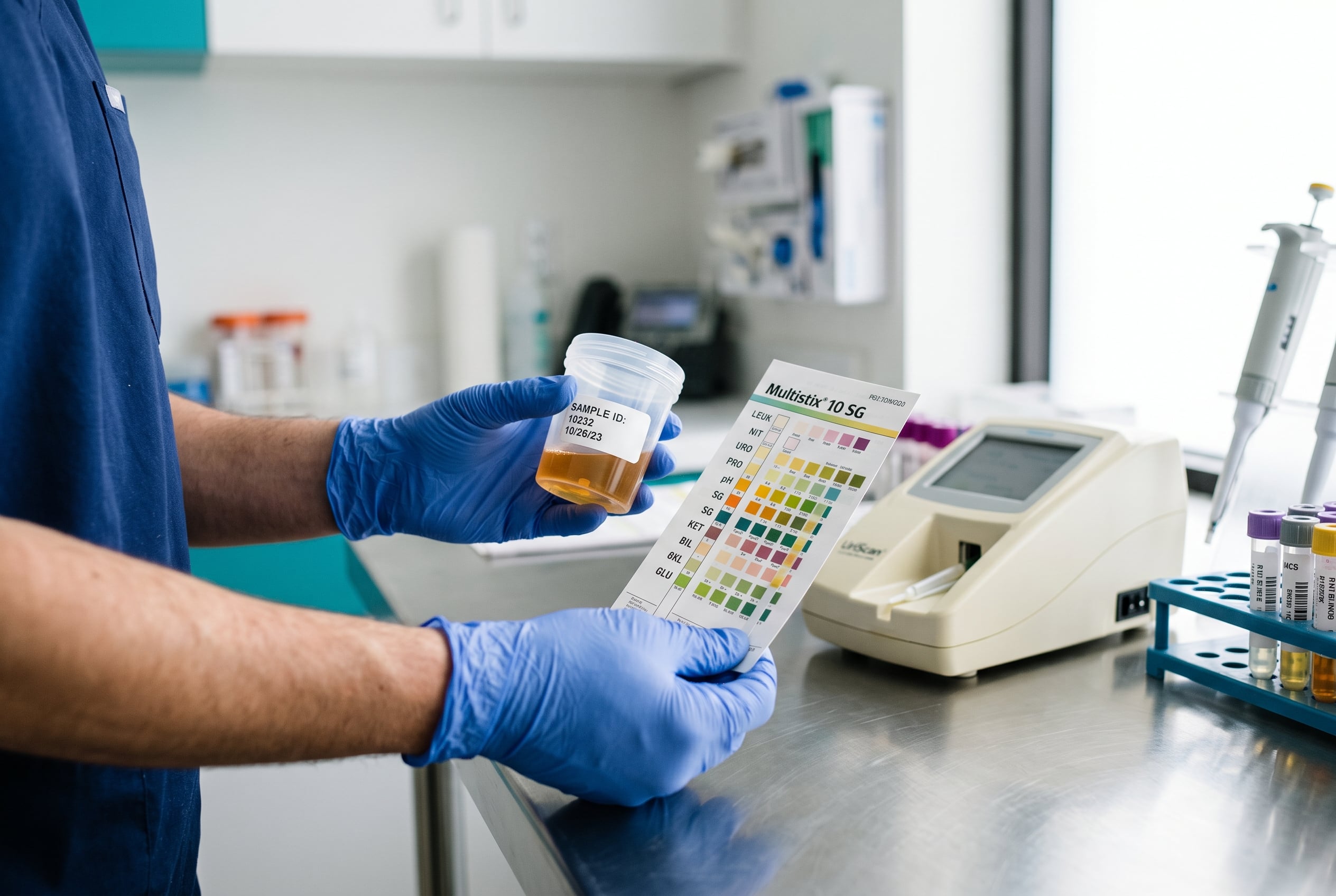
A bladder infection is rarely dangerous in a healthy adult — but it is genuinely miserable, and it gets worse, not better, while you wait for a call back. Urinary retention is a different problem entirely: it's painful, it doesn't resolve on its own, and it needs relief within hours.
Our clinicians evaluate the full range of urinary complaints in adults: painful urination, urgency and frequency, blood in the urine, flank pain, pelvic or lower abdominal pressure, and the inability to urinate at all. We take a history, examine you, run urinalysis in our own lab, and send a urine culture when the situation calls for one. If a bacterial infection is present and treatment is indicated, we start the right antibiotic the same visit and send it electronically to your pharmacy.
We're at 15883 N Oracle Rd, Suite 101, Tucson, AZ 85739 — on North Oracle Road in Catalina, minutes from Rancho Vistoso, Oro Valley, SaddleBrooke, and northwest Tucson. For most of these neighborhoods, we're considerably closer than the nearest emergency department, and a walk-in visit here costs a fraction of what an ER visit does for the same complaint.
Nobody wants to drive across town with a bladder infection. Here's what getting to us looks like from the communities we serve.
About 10 minutes from the Rancho Vistoso Boulevard and Oracle Road intersection, serving Vistoso Highlands, Sun City Oro Valley, and the surrounding neighborhoods. Walk in before work at 7 AM or after, without crossing town.
We're your neighborhood clinic — located in Catalina itself, minutes from the SaddleBrooke communities off Oracle Road. For 85739 residents, this is the closest walk-in option for urinary symptoms or retention, with no drive down into the valley.
Roughly 10 to 15 minutes north on Oracle Road from central Oro Valley, near the Oro Valley Marketplace corridor. Same-day urinalysis and treatment without waiting for a primary care opening.
An easy drive via Tangerine Road or Oracle Road from Marana, Dove Mountain, Continental Ranch, and the northwest corridor. On-site lab and X-ray mean one stop instead of a clinic visit plus a separate lab appointment.
Drive times are approximate and depend on traffic and your exact starting point.
"UTI" is the label most people reach for, but several different problems cause overlapping symptoms — and they're treated very differently. Here's how our clinicians sort them out.
Burning with urination, going constantly, urgency, cloudy or strong-smelling urine, pressure low in the pelvis. No fever, no back pain. This is the most common reason people walk in with urinary symptoms, and the most straightforward to treat.
Bladder symptoms plus fever, shaking chills, nausea or vomiting, and pain in the flank — the side of your back below the ribs. This is a more serious infection that needs a different, longer antibiotic course, and sometimes hospital care.
You need to urinate, you can't, and your lower abdomen feels tight and painful. This is not an infection and antibiotics won't fix it. It needs bladder decompression, usually within hours.
Sudden, severe, wave-like pain in the flank that may travel to the groin, often with blood in the urine and vomiting. People frequently describe it as the worst pain they've experienced. It can occur with or without infection.
Chlamydia and gonorrhea cause burning with urination that feels identical to a bladder infection, sometimes with discharge. A urinalysis alone won't distinguish them. Confidential testing is available during the same visit.
New confusion, unsteadiness, a fall, or a sudden drop in function in an older adult — with or without classic urinary symptoms — deserves an evaluation. Importantly, it also deserves a look for causes other than a UTI. (More on that below.)
💬 Come ready to describe what you're feeling, exactly when it started, whether you've had fever, and whether you've had this before. That history — combined with urinalysis run here in our lab — is what tells us which of these you're dealing with.
This is general guidance, not a diagnosis. Two people with identical symptoms can have entirely different problems — which is why we test rather than guess.
| What You're Feeling | What It Often Means | What We Do |
|---|---|---|
| Burning, urgency, frequency — no fever | Simple bladder infection | Urinalysis on site; short-course antibiotic the same visit when indicated |
| The above plus fever, chills, flank pain, nausea | Possible kidney infection | Exam, urinalysis, urine culture, and a decision about whether outpatient treatment is safe |
| Visible blood in the urine, no burning | Needs a cause identified — stone, infection, medication, or something requiring urologic workup | Urinalysis, evaluation, and a referral pathway if the workup needs to continue |
| Severe one-sided flank pain in waves, radiating to the groin | Possible kidney stone | Exam, urinalysis, pain control, X-ray when useful, and referral for CT imaging and urology when indicated |
| Can't urinate at all; lower abdomen tight and painful | Acute urinary retention | Prompt evaluation and catheter placement for bladder decompression when clinically appropriate |
| Burning plus discharge, or a new partner | Possible STI-related urethritis | Confidential STI testing alongside urinalysis |
| Urinary symptoms while pregnant | Treated more aggressively — even without symptoms | Urinalysis and culture; pregnancy-safe antibiotic selection; OB coordination |
| Urinary symptoms in a man | Never considered "routine" — the prostate is usually involved | Longer, prostate-penetrating antibiotic course and a lower threshold for culture and referral |
| New confusion or a fall in an older adult | Deserves a full evaluation, not an automatic UTI diagnosis | Exam and testing that looks for all likely causes, not just the urine |
Testing, imaging, and treatment in the same building is what keeps this to one stop instead of three.
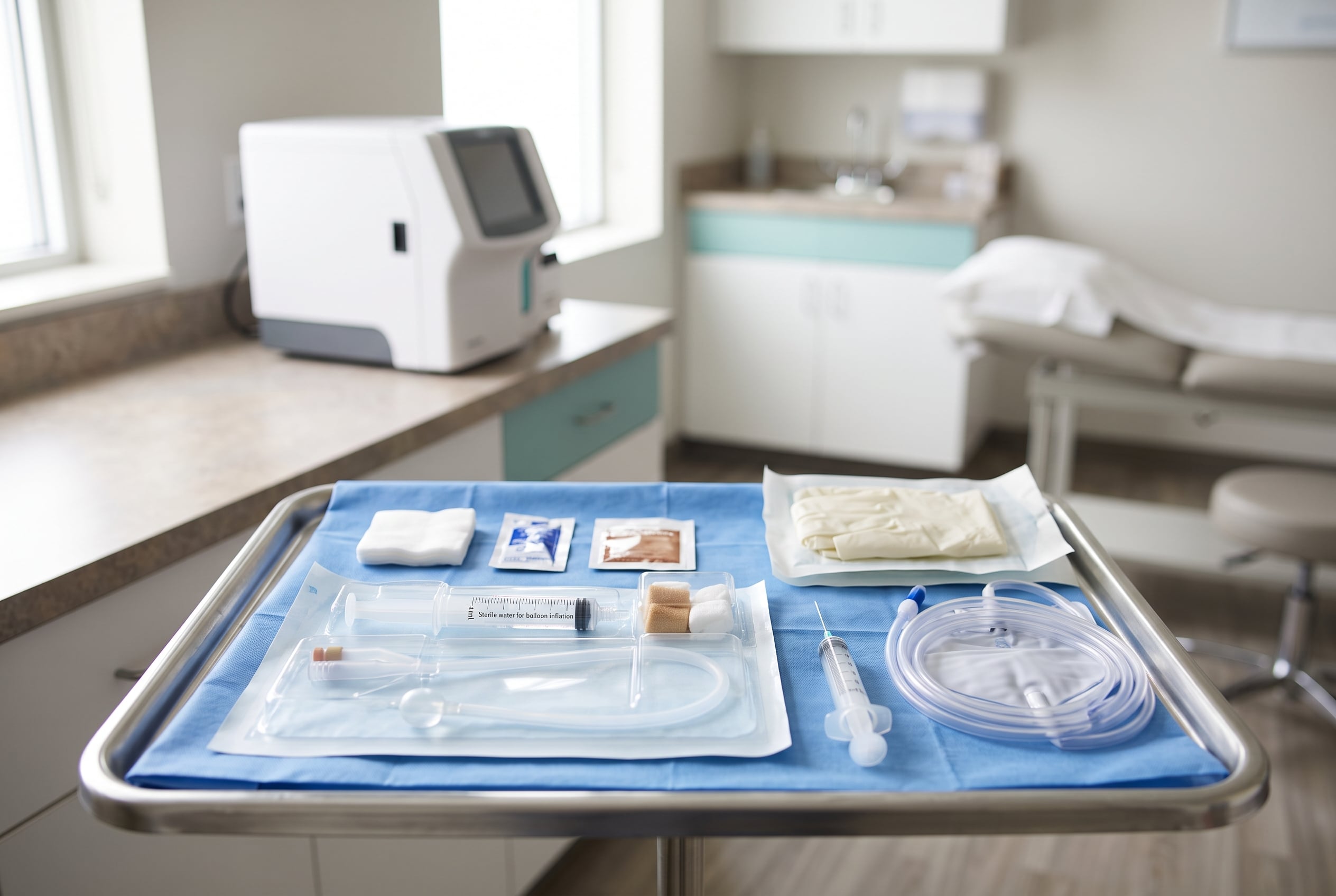
If you cannot urinate and your bladder feels painfully full, that is a true urgent problem. A bladder that stays obstructed becomes more painful by the hour and, left long enough, can injure the kidneys. The fix is straightforward and immediate: decompress the bladder with a catheter. Relief is usually dramatic and comes within minutes.
Most walk-in clinics don't do this and send patients to the emergency department, where the same procedure happens after a long wait and at a far higher cost. Our clinicians evaluate bladder distension and place a Foley catheter when it's clinically indicated.
In men, an enlarged prostate is by far the most common cause. But retention also follows from:
Part of the visit is figuring out why it happened, because that determines what comes next — a medication change, a urology referral, or a plan for removing the catheter.
We'll tell you directly if a catheter cannot be placed safely, if there's evidence of a urethral injury or stricture we shouldn't force past, if there's significant bleeding, or if the presentation suggests a urologic or neurologic emergency. In those situations you need the emergency department or a urologist, and we'll help you get there rather than making several attempts here.
🚨 Inability to urinate combined with numbness in the groin or inner thighs, new leg weakness, or loss of bowel control can indicate cauda equina syndrome — a spinal cord emergency. Go to the emergency department immediately, not to urgent care.
A urinary tract infection in a man is never considered routine. Male anatomy makes bladder infections uncommon, so when one occurs, we look for a reason — an enlarged prostate, incomplete bladder emptying, a stone, or prostate involvement. The prostate also changes the treatment: some antibiotics that work well for women don't penetrate prostate tissue adequately, and the course is typically longer than the three to five days a woman would receive. We culture more readily and refer to urology sooner.
Pregnancy is the one clear situation where bacteria in the urine get treated even when there are no symptoms at all, because untreated infection in pregnancy carries real risk of kidney infection and preterm labor. Antibiotic selection is narrower — several standard UTI drugs are avoided in certain trimesters. We test, culture, choose a pregnancy-appropriate antibiotic, and coordinate with your OB. Fever or flank pain during pregnancy means emergency evaluation, not urgent care.
This is worth being direct about. As people age, bacteria commonly live in the urinary tract without causing infection — a condition called asymptomatic bacteriuria. It shows up on a urine test and looks alarming, but in most cases treating it does no good and real harm: antibiotic side effects, C. difficile colitis, and resistant bacteria that make the next genuine infection harder to treat.
The reflex of attributing every episode of new confusion in an older adult to a UTI and prescribing an antibiotic is a well-documented problem in medicine. Infectious Diseases Society of America guidance recommends that older adults with delirium and a positive urine test, but without urinary symptoms or signs of systemic infection, be evaluated for other causes — dehydration, medication effects, pain, infection elsewhere — with careful observation rather than an automatic antibiotic.
So when an older family member comes in with new confusion or a fall, our job is to do a real evaluation and look at everything, not just the urine cup. If there is a genuine infection, we treat it. If there isn't, we say so and keep looking. That's the more useful answer, even when it isn't the one people expect.
Painful urination, new bedwetting in a previously dry child, or an unexplained fever in a young child can all point to a urinary infection, and urine testing is available on site. See our pediatric urgent care page for how we evaluate children.
Patients sometimes arrive hoping to describe symptoms over the phone and pick up a prescription. We understand the appeal, and there are real reasons we don't work that way. Studies of women who self-diagnose a UTI find that a meaningful share of them have something else — vaginitis, an STI, a kidney stone, interstitial cystitis, or bladder irritation from another cause. Treating all of those with an antibiotic means the actual problem goes untreated for another week while side effects accumulate.
When a bacterial infection is confirmed, we select from the first-line agents recommended by current urologic and infectious disease guidelines — nitrofurantoin, trimethoprim-sulfamethoxazole, or fosfomycin — guided by local resistance patterns and your allergy and medication history. Courses are kept as short as the evidence supports, often three to five days for a simple bladder infection. Fluoroquinolones like ciprofloxacin, once the reflex choice, now carry FDA warnings about tendon, nerve, and joint injury and are reserved for situations where nothing else is appropriate.
If your symptoms don't improve within about 48 hours of starting treatment, that's not a reason to wait it out — call us. It usually means the culture grew something the initial antibiotic doesn't cover, and the fix is switching to the right one.
Phenazopyridine, sold as AZO Urinary Pain Relief and similar products, is a bladder-surface numbing agent. It can genuinely take the edge off burning while you wait to be seen — but it treats no infection whatsoever, and the infection continues progressing underneath the relief. It also turns urine bright orange and permanently stains contact lenses and fabric, and it can make a urine dipstick harder to read, so tell us if you've taken it. It's meant for short-term use, generally no more than two days. Over-the-counter home UTI test strips can suggest an infection, but they can't tell us which bacteria or which antibiotic will work.
Recurrent UTI is generally defined as two episodes of bacterial cystitis within six months, or three within a year. It's common, it's frustrating, and it's worth addressing rather than treating one episode at a time forever.
At the visit we'll culture the urine — recurrent infections are exactly the situation where knowing the specific organism matters — and talk through what's reasonable to try. Current AUA guidance supports several approaches:
Some patterns — infections in men, infections with the same organism repeatedly, stones, or incomplete emptying — warrant a urology referral, and we'll make that recommendation when it's the right call rather than cycling you through another antibiotic.
Living along the Oracle Road corridor changes the picture in ways that generic UTI pages don't cover.
Most people here run drier than they realize, especially May through September. Concentrated urine means less frequent flushing of the bladder and more irritation. If your urine is consistently dark yellow, you're behind — and that's a setup for both infections and stones.
Stone formation rises with heat and dehydration, and southern Arizona summers are a reliable trigger. We can evaluate flank pain, check for infection and blood in the urine, manage pain, and use X-ray where it's useful. A definitive stone workup needs CT imaging, which we'll arrange a referral for.
Long mornings on the Catalina trails or the SaddleBrooke courses, and full days on job sites, both produce the same problem: hours of heavy fluid loss with minimal intake. Heat illness and urinary symptoms frequently arrive together, and we can address both, including IV fluids when they're warranted.
Arriving from a cooler, more humid climate and not adjusting fluid intake is a common source of first-time urinary symptoms in winter visitors. If you're here seasonally and without a local primary care physician, walk-in is the practical option — and we can send records to your physician at home.
| Situation | Best Choice | Why |
|---|---|---|
| Burning, urgency, frequency without fever | Sanova Urgent Care | Urinalysis on site, results the same visit, treatment started before you leave |
| Can't get in with your primary care physician for several days | Sanova Urgent Care | Walk in six days a week, 7 AM to 7 PM |
| Acute urinary retention — can't pass urine | Sanova Urgent Care | Catheter placement available here; far shorter wait and lower cost than an ER |
| Routine management of recurrent UTIs, chronic prostate issues, or incontinence | Sanova Urgent Care or a urologist | Ongoing conditions need continuity, not episodic visits |
| Fever, chills, confusion, vomiting, severe flank pain, or feeling truly unwell | Emergency department / 911 | Needs IV antibiotics, imaging, and hospital-level monitoring |
| Retention with new leg weakness, groin numbness, or loss of bowel control | Emergency department / 911 | Possible spinal emergency |
| Blood in the urine that continues after infection is treated | Urology referral | Requires a full workup that a walk-in visit cannot complete |
A provider takes your history and examines you, we collect a urine sample and run the urinalysis here, and we review the results with you before you leave. When a culture is appropriate, it goes to the lab and we contact you if the results change the plan. Prescriptions go electronically to your pharmacy. You leave with written instructions on what to watch for and when to come back — and, if a catheter was placed, clear direction on care and follow-up.
Sanova Urgent Care sits on North Oracle Road in Catalina, with free parking directly outside Suite 101 and no appointment required at any time we're open. We're the walk-in option for urinary and bladder care for patients in Catalina, Oro Valley, Rancho Vistoso, SaddleBrooke, Sun City Oro Valley, northwest Tucson, Marana, Oracle, San Manuel, and Mammoth.
For most of the 85739, 85737, 85755, 85742, and 85704 ZIP codes, we're considerably closer than any hospital emergency department — which matters when you're managing bladder pain and would rather not spend an afternoon in a waiting room.
Everything you need to know before your visit. Can’t find your answer? Call us at (520) 232-2525.
Dealing with urinary symptoms or retention? Walk in or call 520-232-2525.
We use cookies to improve your experience on our site. By using our site, you consent to cookies.
Manage your cookie preferences below:
Essential cookies enable basic functions and are necessary for the proper function of the website.
These cookies are needed for adding comments on this website.
Statistics cookies collect information anonymously. This information helps us understand how visitors use our website.
Google Analytics is a powerful tool that tracks and analyzes website traffic for informed marketing decisions.
Service URL: policies.google.com (opens in a new window)